Learning the Market the Hard Way
I have written books about education, Florida, climate upheaval, social dysfunction, poetry, Dada, and assorted forms of absurdity. So perhaps it was inevitable that sooner or later I would write about Wall Street.
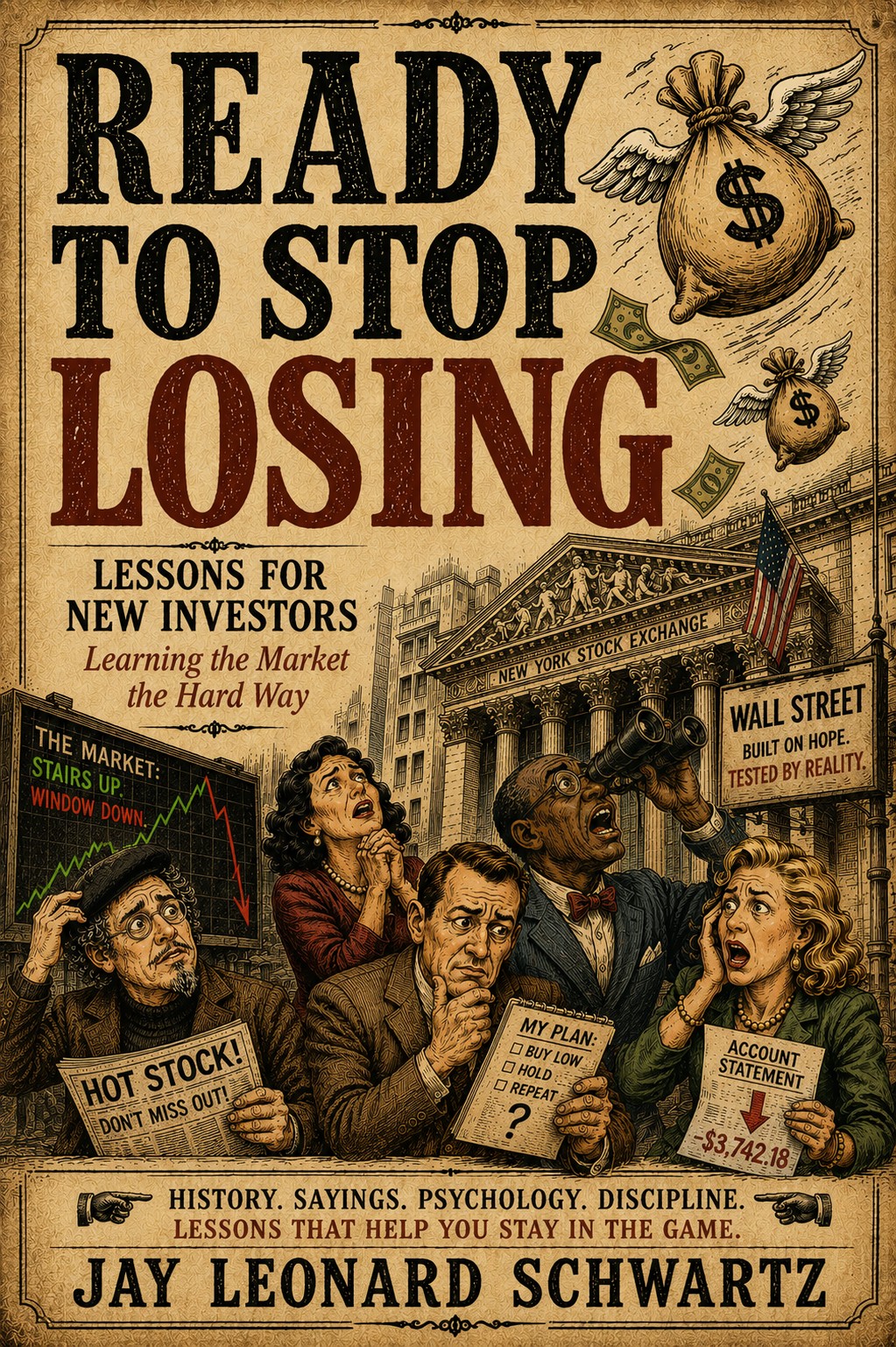
My new book, “Ready to Stop Losing: Lessons for New Investors Learning the Market the Hard Way,” grew out of my own experience entering the stock market and discovering that much of what makes investing difficult has surprisingly less to do with understanding numbers and, unsurprisingly, much more to do with understanding ourselves.
Now, I can be honest in saying that I am not a stock expert. I am not an analyst. I am not an economist. I do not own or manage a hedge fund. In fact, I wouldn’t even call what I offer in the book advice—certainly not financial advice—but rather an education based on my experience, as well as my interest in the lore and lure of this phenomenon we know as “Wall Street.”
Mostly, the book is about learning patience, taming impulse, and not feeling so stupid for losing money. Isn’t it always true that “experience,” particularly when it costs you money, has a way of getting your attention?
The Learning Curve
One of the first things I discovered about investing in the stock market was that there really is a learning curve—and it doesn’t play nicely. In fact, it simply defies your expectations, just as surely as you end up defying your own.
Talk about learning from your mistakes. One day, you learn something and think you finally understand what you’re doing. Then the market does something else. A stock you thought was cheap gets cheaper. A dividend that looked attractive begins to look suspicious. Something you sold takes off without you. Something you confidently bought heads in the opposite direction. You take the time to listen to all the “experts,” if not everyone around you … and still you find yourself losing money. “How stupid am I?” you wonder.
Well, folks, I’m here to tell you, “Don’t take it personally.” It’s not about you. In fact, as I write in my book, the market doesn’t care about you. And yet, what does matter is what you do.
What an amazing contradiction!
That became one of the central ideas behind “Ready to Stop Losing.”
The book is not about “beating the market.” It certainly is not another promise of financial freedom through perfect discipline, dividend snowballs, magical compounding charts, or a foolproof system to get rich quick.
Surely, there are enough books like that already.
Nope. This is a smaller, more human book about what investing actually feels like for ordinary people trying to navigate a noisy world of financial slogans, contradictory advice, market hype, uncertainty, and limited resources without losing their shirt—or their sanity.
Money, Psychology, and Behavior
I am an educator and teacher-trainer. I studied psychology, including behavioral psychology, as well as business. Over the years, I have become increasingly interested in cognitive psychology, behavioral economics, learning theory, and self-regulation.
My approach to the subject probably has something to do with where I came from professionally. Last year, I published “What About the Teacher?” It’s a book for teachers that, in part, fosters reflective teaching and self-actualization. I began to think: How might I do the same for new investors?
But that’s all academic, and those fields become remarkably relevant once you put your own money at risk!
In working on myself, I began to consider that I wasn’t alone in this experience. As an educator, at least for me, that means sharing my experience to help others.
At the same time, I was developing some material for my students about the history of the stock market and the wisdom of some of the many quotes and idiomatic, folkloric-like sayings often used to admonish and advise investors—from falling knives and dead cat bounces to rising tides and stock prices taking the stairs up and the window down.
Investing gives fear, greed, impatience, hope, regret, stubbornness, and ego an extraordinarily efficient laboratory in which to operate, and, at least for me, yet another creative sandbox in which to play.
You can know perfectly well what you should do and still do something else.
You can tell yourself not to chase a stock—and then find yourself chasing it.
You can tell yourself that a falling price does not necessarily make something a bargain—and buy more simply because it is cheaper.
You can develop a perfectly sensible plan and then abandon it because a stream of red numbers on a screen makes you nervous and uncomfortable.
That gap between knowing and doing interests me. It is also why the book spends as much time examining the investor as the investment.
As I put it in the book, this is ultimately about what people do when money, risk, ego, and emotion collide.
The Wall Street Mystique
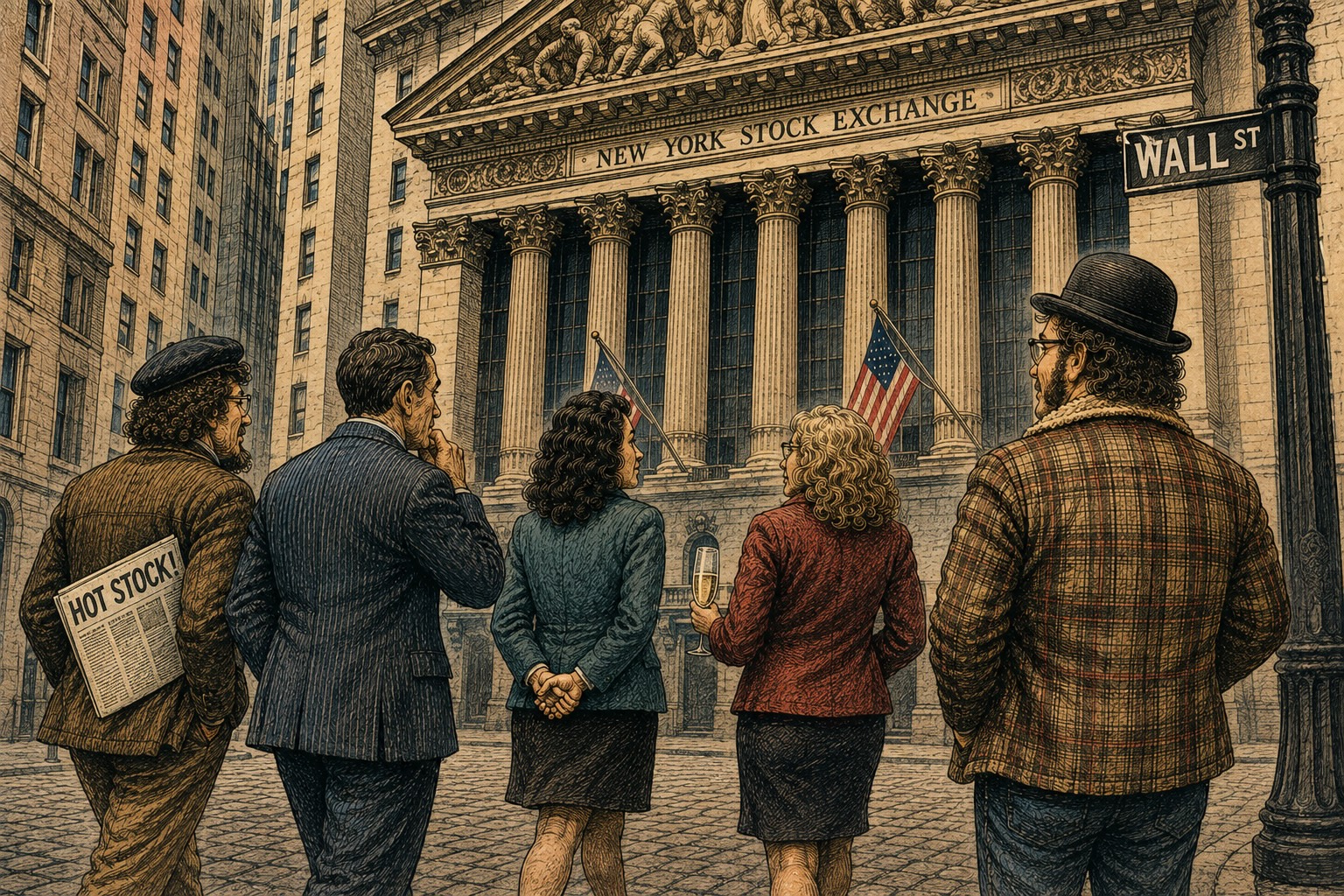
Wall Street had been floating around in my imagination since childhood.
For me, as a TV-obsessed kid in Miami, it was flashing neon stock tickers streaming across financial displays in Times Square, New York. It was the whole theater of money in motion: the Monopoly man, Mr. Thurston Howell III on Gilligan’s Island, J.P. Morgan, aristocrats, martini glasses, banksters, and the Jet Set.
Even Mr. Peanut—with his top hat, monocle, and cane—somehow seemed to belong in the same great old club as the Rockefellers, Vanderbilts, and Carnegies.
It was a cavalcade of symbols, characters, and stereotypes saturated with glamour, greed, wealth, power, and spectacle.
And that mythology matters.
The market presents itself as something rational: earnings, valuations, interest rates, balance sheets, charts, and percentages. But surrounding all those numbers is an enormous cultural apparatus built around money, success, fear, status and the promise of getting rich.
Small investors walk into that world carrying their own hopes and vulnerabilities with them.
Joseph Ferdinand Keppler captured something remarkably similar in an 1881 Puck cartoon called Cut-throat Business in Wall Street: How the Inexperienced Lose Their Heads. The inexperienced investors heading toward the New York Stock Exchange were labeled “The Lambs Brigade.”
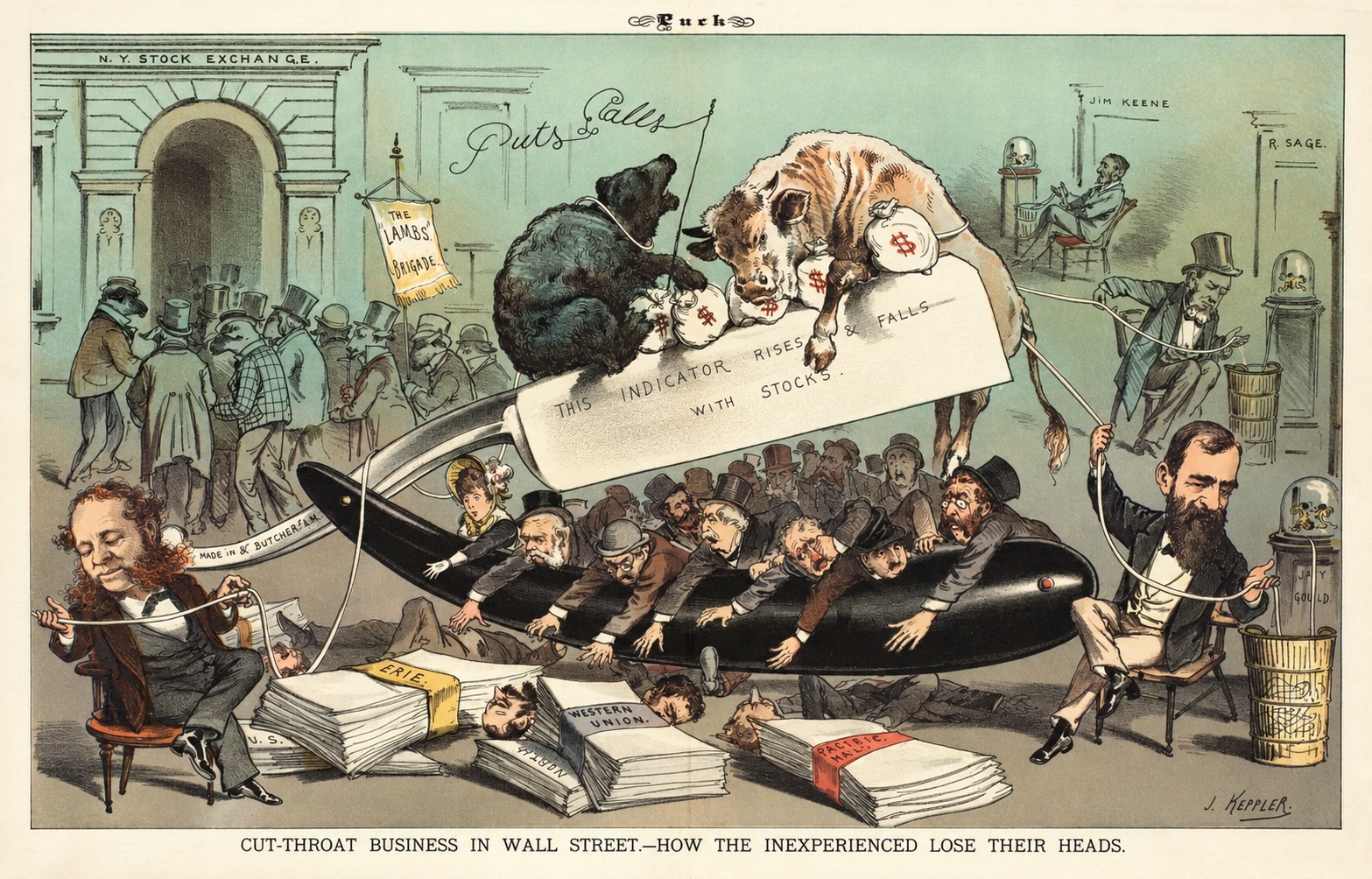
They were ordinary people—hopeful, inexperienced, and unaware of how much the game favored people who already understood its rules.
More than 140 years later, the image hasn’t entirely lost its relevance.
What “Ready to Stop Losing” Is About
Ultimately, I found myself writing a book that grew out of that collision between the mythology of investing and the experience of actually doing it.
It deals with practical subjects—stocks, dividends, valuation, cost basis, diversification, trends, limit and stop orders, falling prices, risk, cash, and the eternal question of when to buy, sell, hold or simply leave something alone.
But running underneath those subjects is another set of questions.
What does it feel like to build a portfolio slowly, perhaps one share at a time? Why can supposedly “safe” investments suddenly feel anything but safe? What happens psychologically when a position drops below your cost basis? What is the difference between wealth on a brokerage screen and money you can actually use? And what do you do when financial experts speak confidently in abstractions that don’t translate particularly well into ordinary life?
The book also takes on some of Wall Street’s favorite sayings:
“Set It and Forget It.”
“Don’t Time the Market.”
“Cash Is King.”
Certainly, there is usually some wisdom buried in sayings like these. The problem begins, however, when useful ideas harden into commandments. As a nonconformist, that irks me to no end.
Investing is filled with slogans precisely because slogans make complicated things sound simple.
Of course, we often find that “real life” has an annoying habit of being more complicated.
So rather than treating conventional market wisdom as sacred truth, I wanted to look at what it means when filtered through the lives of small investors, late starters, cautious people, aging people, self-taught people, and anyone else trying to participate in investing without allowing it to consume them. My first thought was, “Why not write a book for new investors to help them stop losing money and stop feeling stupid as they try to overcome the learning curve?”

Welcome to the Learning Curve
Ready to Stop Losing is therefore not a formula for beating Wall Street.
And in truth, I don’t have one.
But it is a book about learning—sometimes through mistakes, sometimes through observation, and sometimes through discovering that something you confidently believed yesterday needs reconsidering today.
It is skeptical at times, occasionally humorous, deliberately conversational, and intentionally human-scaled. It assumes neither wealth nor expertise. Most importantly, it doesn’t pretend that certainty exists where it doesn’t.
I believe that the market’s hardest lessons are rarely about numbers alone. They are about what happens when money, risk, hope, ego, and fear all arrive in the same room—and whether we can develop enough patience and discipline to keep them from making our decisions for us.
That is the education I found myself getting. That is the lesson I wanted to share.
And that is what became “Ready to Stop Losing: Lessons for New Investors Learning the Market the Hard Way.”
The book is now available in Kindle and paperback editions on Amazon.
Welcome to the market. Welcome to the learning curve.

All through the year, give the gift that keeps on confusing—one of my novels! My latest absurd work is Tricksters, Crackers and Gods, part of my Lost Florida series.
Available in Kindle and Paperback. Read it. Gift it. Do it.


What you say about building a portfolio “perhaps one share at a time” and about wealth on a screen being a different animal from money you can actually use, landed on me in a way I was not expecting. I am ordering the book for my sister, who is in the middle of the exact “how stupid am I” spiral you describe. I think she willl feel less alone for having it on her nightstand.
LikeLiked by 1 person
Many thanks for your kind words, Bret. I appreciate the feedback and it brings your sister much comfort—and soft landing from the vicious spiral!
LikeLike