A Loitering Words Essay
There is rarely a meeting point between my Loitering Words persona and that of my ELT Vista self. The former writes with a chipped tooth, a leather vest, a jester motif, and a sly-eyed grin; the latter wears a blazer, or sometimes a black tie. Nonetheless, in this article— which may end up as a podcast, a rant, a performance, or a plea—I intend to bring both to the table, not to find a middle ground, but to come at you with both barrels blazing.
I write this post fully aware that slowly but surely, attempts will be made to shut me up. It is what always happens whenever someone challenges the gatekeepers’ favorite myth: that censorship is care and confiscation is a form of moral hygiene.
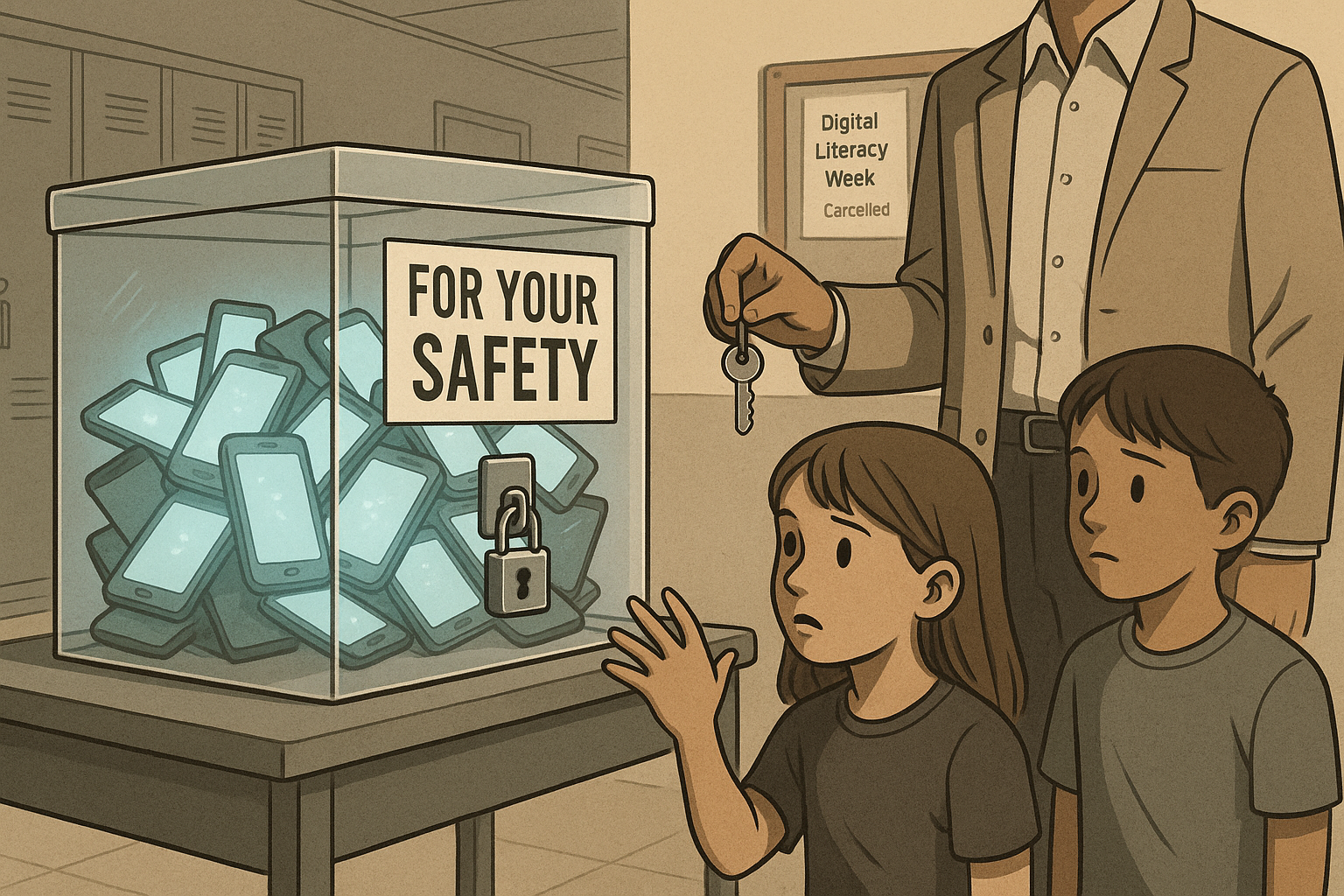
Today’s contention is the recent Australian ban on social media for children under sixteen—you know those post pubescent, randy teens, easy pickings and already labeled a “lost generation” by the vegemighty powers that be. The answer is always to take something away when you cannot control the message. No need for innovation, imagination, or investment. Just take. The political equivalent of grounding a teenager because you do not know what else to do. Take. Take. Take. Offer nothing in return … It’s the same old story.
To be fair, there is a sliver of respectable ideology behind the decision. We all know perfectly well that mainstream media—not just social media—has created a monster, a pop-fueled hydra fed by outrage, fear, and profit. In my youth, television was the enemy; the boob tube, the idiot box. The 1960s TV, for all its flaws, was infinitely better than the real-life alternative: racism, bible-thumping (or humping), and the mind-numbing tedium of bottom-up education designed to pacify, not enlighten—plus the added bonus of the National Guard mowing down hippies and flower power at Kent State while the draft office shipped Johnny off to war in Vietnam in the name of order, and, of course, the American way of something or another, sometimes spelled d-e-m-o-c-r-a-c-y, which, like pizza, hamburgers, and spaghetti, many Americans think they invented. Sticks and stones, wood and glass—and govern yourselves accordingly.
Yet the real truth was this: slowly, almost imperceptibly, youth culture grew smarter and more attuned to hypocrisy than the “greatest” generation before it. Predictably, censorship surged. It is not that censorship had ever gone away; rather, the so-called Moral Majority girded its fig-covered loins and reasserted itself to stop the spread of “equality for all.” That equality was always the real threat, wasn’t it.
Here in the USA, or at least in Florida, the same year equal-rights legislation took a step toward actuality and bussing was proposed as a desperate patch for the catastrophic failures of integration, other legislation conveniently emerged allowing private white and WASPY religious schools to open under the sanctified guise of “religious freedom.” Why? Because some people were terrified that children might actually talk to one another. It is the same today—only in Australia, in all its former penal-colony, sun-scorched self-assurance, the flashpoint has arrived again.
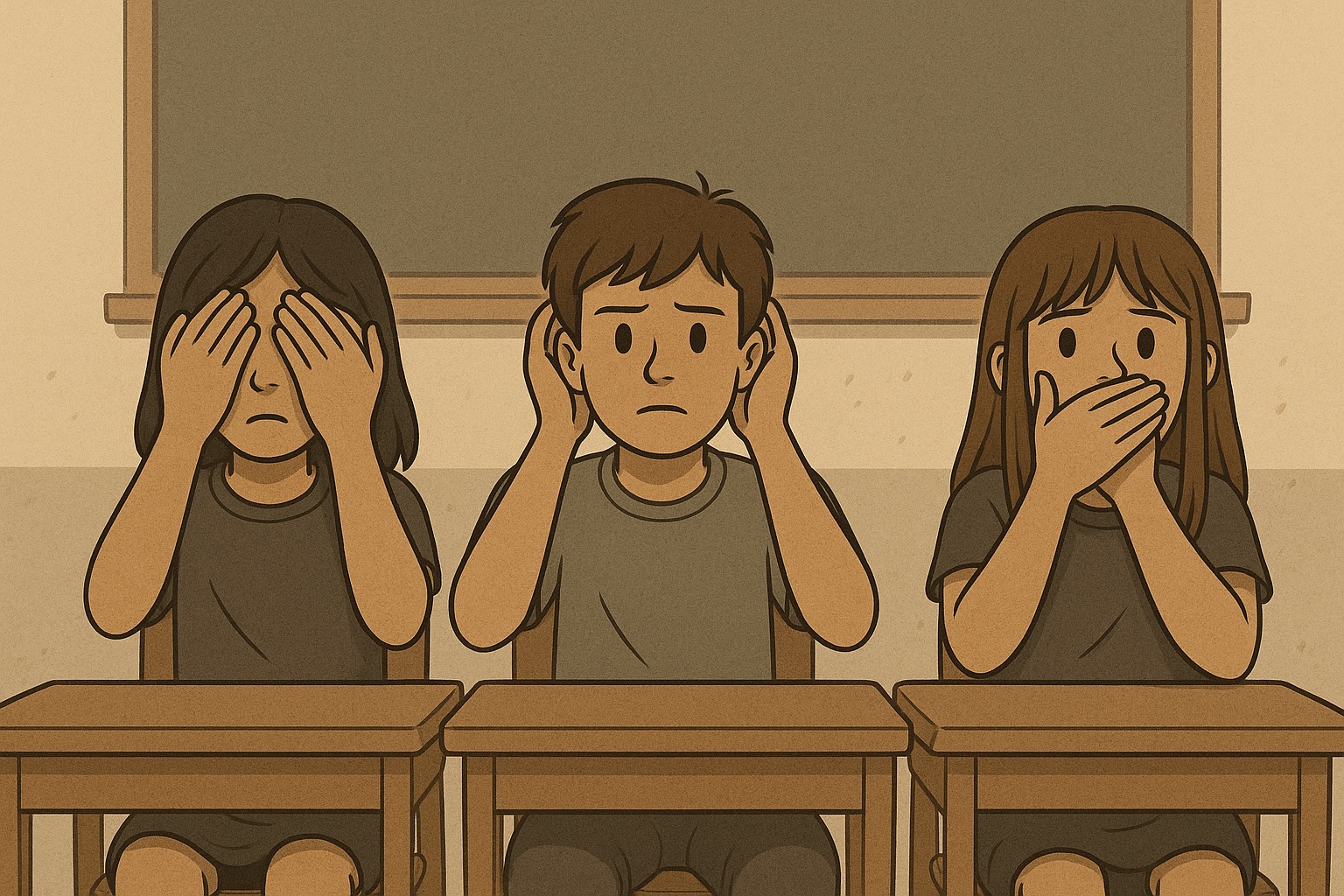
On my ELT Vista site, I wrote a much calmer academic piece—no sulfur, no sparks, no righteous indignation. Naturally, when attempting to illustrate the article with some graphics, my dada sensibility took over and I asked ChatGPT to fashion an image of a teacher telling their students to go play with sticks, stones, wood, glass, or even themselves. Yes, risqué. Yes, irreverent. Yes, quite witty, I‘d say and I think Oscar Wilde might agree. But art has always been guilty of that terrible offense: pointing to the absurdity of the rules designed to contain it.

ChatGPT refused. Not because of the innuendo (which it openly acknowledged it understood) but because it claimed I was promoting activities that might “hurt” children—playing with glass and wood. The self-harm excuse, not the sexuality. Even AI has learned the rituals of contemporary censorship: ignore the subtext, flatten the art, sanitize the provocation. In the end, I wound up with bland, wooden images smacking of wet cardboard humor. You can see them. You will not be impressed, unless you like that sort of dull, dry, and droll state that comes with social suppression.
As a humanistic educator, I now ask: What exactly does the Australian government plan to offer young people to replace what they are taking away? What new infrastructure of expression, creativity, belonging, and critical literacy stands ready to receive this “lost generation”? Nothing. The answer is always nothing. Take away privileges—if not rights—and offer no alternatives. Freedom of expression is worthless without freedom of reception. Censorship is population control masquerading as paternal concern. Honor the rod, rot the child. Know what I mean? I think you do.
Mainstream media, of course, gets the final say in mischaracterizing dissent. The Beat Generation became Beatniks: berets, bongos, and harmless caricature. The dadaists—too dangerous to ignore—were reduced to the image of any fool wearing a toilet seat around their neck and babbling nonsense. The strategy never changes: mock what you can’t silence, distort what you can’t contain.
And because I know some people will accuse me of exaggeration, hysteria, or reading too much into it, let me offer the following receipts.
HISTORICAL INCONVENIENCES
(a.k.a. The Part Where I Show My Homework)
1. Australia’s Long Love Affair with Censorship (Australia)
- Customs Act 1901: Australian border agents empowered to ban “undesirable” books.
- Banned for decades: Ulysses, Brave New World, Lolita, Tropic of Cancer, multiple D.H. Lawrence works.
- Australia maintained bans long after the UK and US had lifted theirs. Moral crusades do not respect expiration dates.
2. Every New Medium = The End of Civilization (Primarily United States & Western Nations)
- United States, 1950s: Television accused of “destroying moral fibre” and corrupting youth.
- United States, 1954: Senate hearings lead to the Comics Code Authority, blaming comic books for juvenile delinquency.
- United States, 1990s: Video games blamed for school shootings despite lack of causal evidence.
- Global, 2010s→present: Social media becomes the universal scapegoat for everything short of continental drift.
Geographically distributed hysteria, identical choreography! In truth, adults aren’t afraid of technology. They’re afraid of unsupervised youth using it.
3. The Remove-Without-Replace Formula (Global Across the 19th–21st Centuries)
The pattern repeats across regions:
- Victorian Britain & the U.S.: Ban “immoral” novels → offer nothing.
- United States, 1950s: Blacklist artists during McCarthyism → offer nothing.
- Soviet Union, 1960s–80s: Ban Western rock and jazz → offer nothing.
- China, 2010s→present: Restrict minors’ gaming & internet access → offer nothing.
- Australia, 2025: Ban social media for teens → offer absolutely nothing.
A 2024 OECD review confirms digital access restrictions only work when accompanied by substantial youth-centered replacement programs. Australia proposed none.
4. How Media Defangs Dissent (United States, Primarily)
- U.S., 1958: Journalist Herb Caen coins “Beatnik” to mock the Beat Generation and link them to communism.
- U.S. television, 1960s: Beats recast as harmless bohemian caricatures with bongos and berets.
- Allen Ginsberg repeatedly noted the portrayal was intentional: ridicule is the cheaper cousin of censorship.
Mock the movement → neutralize its politics → sell the costume. Hurrah! Hurrah!
5. Dada: The Original Community Guidelines Violation (Switzerland, Germany, France)
- Zurich, 1916: Dada born at Cabaret Voltaire in direct response to European nationalism and World War I.
- Hugo Ball declares: “Every word that is spoken is an unnecessary lie.”
- Tristan Tzara aims to “destroy the drawers of the brain.”
- Berlin Dada exhibitions raided by police; works deemed obscene or “degenerate.”
- Paris & Berlin authorities routinely shut down shows and confiscated publications.
If Dada launched an Instagram page today, the algorithm would shadow-ban it before the first manifesto hit the feed.
6. Media Monopolies Build the Monster, Then Blame the Children (U.S., U.K., Global)
- U.S., 1938: War of the Worlds panic blamed on gullible listeners—not the broadcasters who engineered the spectacle.
- U.K. & U.S., 1960s–80s: Television blamed for societal violence while networks cashed record profits.
- Global, 2010s→present: Social media outrage is algorithmically amplified because moral panic is profitable.
Governments then swoop in to “save the children,” carefully avoiding any confrontation with the corporate architectures that built the disaster.
Back to the Present (Where the Pattern Repeats Itself)
Censorship always arrives dressed as protection, but it never carries anything in its pockets. It doesn’t bring investments in culture, youth centers, digital literacy, or mental health. It brings confiscation. It brings silence. It brings the smug satisfaction of having “done something,” even when that something solves nothing.
Australia’s youth are told they are a problem. Then they are told they cannot speak. Then they are told this silencing is for their own good. Meanwhile, the rest of us watch the pattern repeat itself—again—and pretend we don’t recognize the choreography.
Because history is clear:
– When the young start thinking, the old start panicking.
– When the young start talking, the censors arrive.
– When the young start building culture, the gatekeepers call it deviance.
Maybe that is why Dada still matters. Because under the absurdity, the laughter, the nonsense syllables and the shredded newspapers, the Dadaists understood one eternal truth:
And remember kiddies, the system is never afraid of silence. It is afraid of voices.
My much more tempered articles for TESOL teachers can be found on the ELT Vista website. ELT Vista also offers an online certificate course on humanistic TESOL teaching based on our book, What About The Teacher? A humanistic guide to self-actualization for TESOL teachers seeking personal and professional development.

On the other hand, you can always read my last absurd novel, Tricksters, Crackers and Gods or others novels.
 Loitering Words