
There’s a strange kind of wisdom that sometimes falls from the lips of fools. Polonius, that verbose courtier from Hamlet, is a prime example. For all his meddling and pomp, he delivers one of the most memorable lines in Shakespeare’s canon: “To thine own self be true.” The irony, of course, is that the man who says it is anything but. Yet the line endures. It endures because, like so much in life, truth is not always delivered by the most trustworthy messengers.
That’s not a bug in the system—it’s a feature. Truth, especially the kind that touches us, doesn’t depend on the purity of its source. In fact, one of the most useful critical thinking habits we can cultivate is separating message from messenger. The wisdom of Polonius isn’t invalidated by his hypocrisy. It’s sharpened by it.
This paradox is especially relevant for teachers—language teachers in particular—who often find themselves navigating between their ideals and the realities of institutional roles, global hierarchies, and personal insecurities. The classroom is part stage, part sanctuary, and the person standing at the front is never just a grammar technician. They are performer, guide, cultural ambassador, disciplinarian, nurturer, and occasionally, reluctant bureaucrat. However, how does one stay true to oneself amid all these shifting roles?
One answer lies in embracing the absurd. Enter the Dadaists.
Born in the ashes of World War I, Dada was not just an art movement—it was a rebellion against meaninglessness. Or rather, a rebellion through meaninglessness. Dada artists like Tristan Tzara, Hugo Ball, and Hannah Höch hurled absurdity at the structures they believed had failed humanity: nationalism, rationalism, and aesthetic conformity. They celebrated nonsense as a kind of emotional protest. They mocked formality, ridiculed hierarchy, and embraced contradiction. However, beneath all the satire and surrealism, the Dadaists were sincere—achingly so. Their absurdity was not nihilism. It was the howl of people trying to reclaim their humanity through radical honesty.
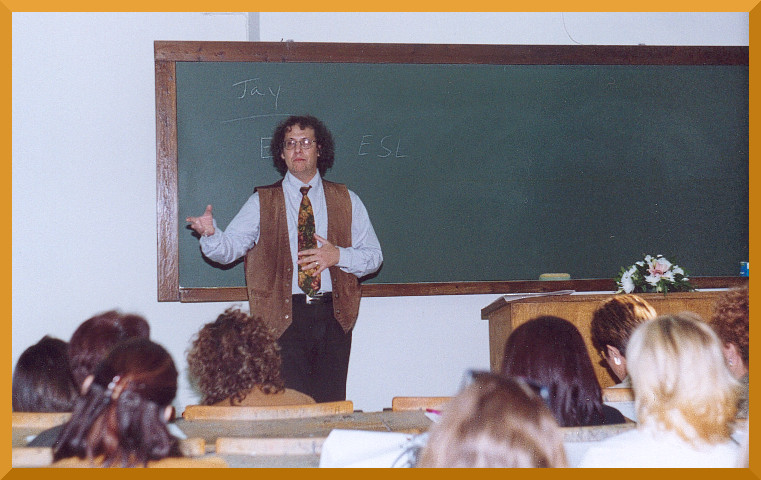
Teachers, in their own quieter way, often perform a similar dance. They work inside systems they didn’t create, using materials they didn’t always choose, enacting policies they might not endorse. Nevertheless, they still try to show up for their students with care and authenticity. They still try to mean what they say. It is a kind of Dadaism by daylight—a rebellion that wears a blazer instead of a clown nose.
Moreover, behavioral psychology joins the conversation. From a behavioral lens, being “true to oneself” is not a static identity—it is a pattern of behavior. Authenticity is enacted. When teachers align their actions with their values—when they speak, correct, question, praise, and model in ways that reflect who they are—they reinforce that alignment. The behavior becomes a habit. It conditions other behaviors. Over time, they build a professional self that is not a mask, but an extension.
This does not mean perfection. It means congruence.
Students notice. They may not be able to articulate it, but they feel it. When a teacher is authentic, students are more likely to take risks, to speak freely, to trust the process. Emotional safety flourishes not just through kindness, but through consistency. Through presence. Through showing up whole.
“To thine own self be true” is not just a nice sentiment or a literary flourish. For teachers, especially those navigating the cultural crosscurrents of EFL and ESL contexts, it is a behavioral invitation: show up as yourself, even when the system tempts you to perform someone else.

So, yes, Polonius was a hypocrite, and, yes, the Dadaists often contradicted themselves. Yet, maybe that’s the point: integrity isn’t about moral purity. It is about intention and practice. It is about living out your values, even when your costume changes. Moreover, it’s about showing up—fully, consciously, and vulnerably—in a profession still shadowed by imperialism, expectation, and performance. It is not just authenticity—it is a quiet act of rebellion.
Sometimes, the fool tells the truth. Sometimes, nonsense reveals the most sense. Sometimes, the teacher, by being true to themselves, gives their students permission to do the same.
Author’s note: I thought twice about posting the above teaching article on this my creative sandbox blog. I am currently editing a book I’ve written on self-actualization for language teachers—and I am after all a teacher-trainer and materials developer beside dadaist at large.
Personal note: I thought twice about posting the above teaching article on this, my creative sandbox blog. I am currently editing a book I’ve written on self-actualization for language teachers—and I am, after all, a TESOL teacher-trainer and materials developer, besides a Dadaist at large. Still, in the effort to balance my two wildly divergent natures—especially in the name of self-actualization—I’ve posted it here. I hope that my book for teachers, as well as a new Lost Florida novel, will be published fairly soon. Details to come.
– Jay
 Loitering Words